
Introduction
In today’s digital economy, data has become one of the most valuable resources for organizations across the globe. Every interaction generates data that can be analyzed using types of data analytics. This is why understanding the types of data analytics and their applications is more important than ever.
Businesses use data analytics to improve decision-making, enhance customer experience, and stay competitive in the market. From small startups to multinational corporations, everyone relies on data-driven strategies. In this blog, we will explore the types of data analytics and their applications, along with their benefits, challenges, real-world example.
What is Data Analytics?
Data analytics refers to the process of collecting, organizing, and analyzing raw data to extract useful information. It involves various tools, techniques, and algorithms that help in identifying patterns, trends, and relationships within data.
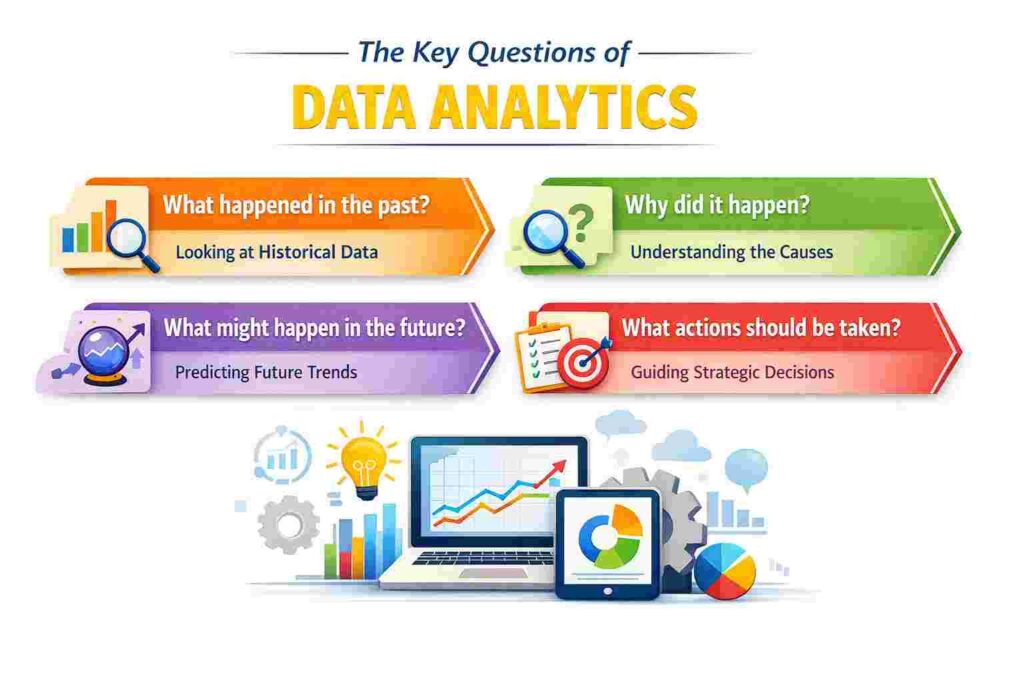
The main objective of data analytics is to support decision-making by answering key questions such as:
• What happened in the past?
• Why did it happen?
• What might happen in the future?
• What actions should be taken?
These questions form the foundation for understanding the types of data analytics and their applications in real-world sce
Types of Data Analytics and Their Applications
There are four primary categories that define the types of data analytics and their applications. Each type serves a different purpose and plays a unique role in decision-makinptive Analytics
1.Descriptive analytics
Descriptive analytics is the most basic form of data analytics. It focuses on summarizing historical data to understand what has already happened.
This type of analytics uses techniques such as data aggregation, reporting, and data mining. It helps organizations gain a clear view of past performance and identify trends.
Applications:
• Monthly sales reports
• Website traffic analysis
• Customer behavior tracking
• Financial performance analysis
Example:
A retail company analyzes past sales data to determine which products were most popular during a specific season. This is one of the simplest examples of the types of data analytics and their applications in action.
2. Diagnostic Analytics
Diagnostic analytics goes a step further by identifying the reasons behind past events.It provides a response to the query, “Why did it happen?”
This type involves techniques such as drill-down analysis, correlation analysis, and root cause analysis. It helps businesses understand the factors that influenced certain outcomes.
Applications:
• Identifying reasons for declining sales
• Analyzing customer complaints
• Investigating operational issues
Example:
If a company notices a drop in revenue, diagnostic analytics can help determine whether it was due to pricing, competition, or customer dissatisfaction. This makes it an essential part of the types of data analytics and their applications.
3. Predictive Analytics
Predictive analytics focuses on forecasting future outcomes using historical data and statistical models. It uses machine learning algorithms and data modeling techniques to identify patterns and predict trends.
Applications:
• Demand forecasting
• Fraud detection
• Customer churn prediction
• Stock market analysis
Example:
E-commerce platforms predict what products customers are likely to buy based on their browsing and purchase history. This highlights the importance of the types of data analytics and their applications in shaping future strategies.
4. Prescriptive Analytics
Prescriptive analytics is the most advanced form of data analytics. It offers recommendations for the optimal course of action in addition to forecasting future events.
It uses optimization techniques, simulation models, and decision-making algorithms to provide recommendations.
Applications:
• Supply chain optimization
• Pricing strategies
• Risk management
• Personalized marketing
Example:
A logistics company uses prescriptive analytics to determine the fastest delivery routes, saving time and reducing costs. This demonstrates how the types of data analytics and their applications can directly impact efficiency.
Applications of Data Analytics Across Industries
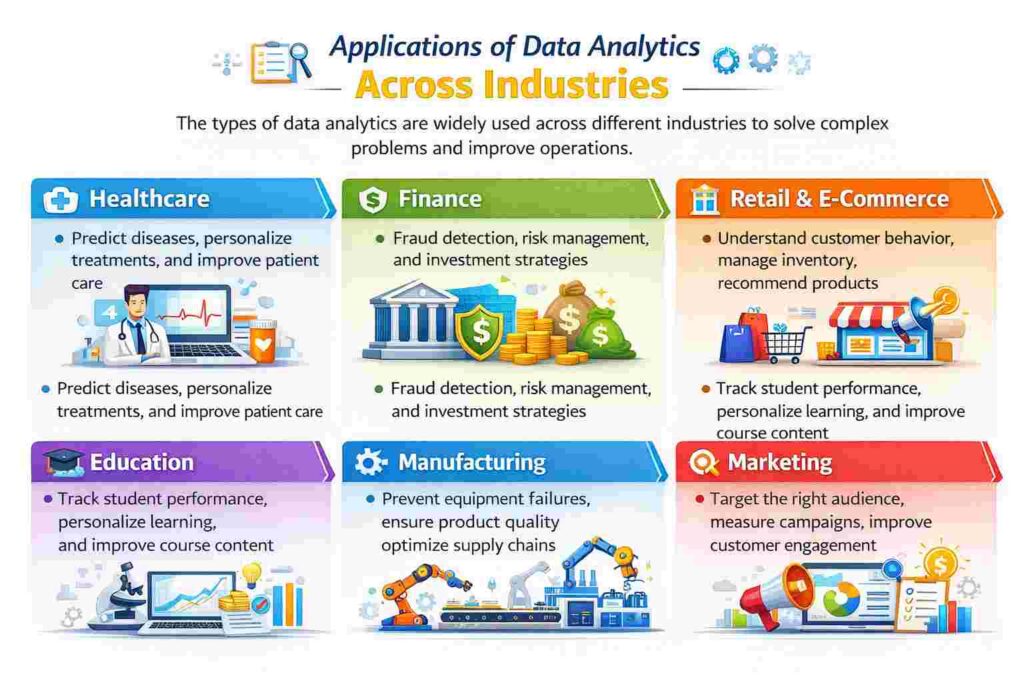
The types of data analytics and their applications are widely used across different industries to solve complex problems and improve operations.
Healthcare
Data analytics is used to predict diseases, personalize treatments, and improve patient care. Hospitals analyze patient data to enhance efficiency and reduce costs.
Finance
Banks and financial institutions use analytics for fraud detection, risk management, and investment strategies. It helps in making secure and informed financial decisions.
Retail and E-commerce
Retailers use analytics to understand customer behavior, manage inventory, and recommend products. Sales and customer satisfaction both rise as a result.
Education
Educational institutions use data analytics to track student performance, personalize learning experiences, and improve course content.
Manufacturing
Manufacturers use predictive analytics to prevent equipment failures and ensure product quality. It also contributes to supply chain optimisation.
Marketing
Marketing teams use analytics to target the right audience, measure campaign performance, and improve customer engagement. This shows how the types of data analytics and their applications play a key role in business growth.
Pros and Cons of Data Analytics
Pros of Data Analytics Cons of Data Analytics
Improves decision-making Requires skilled professionals
Enhances efficiency High implementation costs
Enables future predictions Data privacy concerns
Boosts customer experience Risk of inaccurate data
Identifies new opportunities Complex tools and systems
Supports business growth Time-consuming processes
Understanding these advantages and disadvantages is important when evaluating the types of data analytics and their applications in real-world situations.
Real-World Examples
To better understand the types of data analytics and their applications, let’s look at some practical examples:
Netflix:
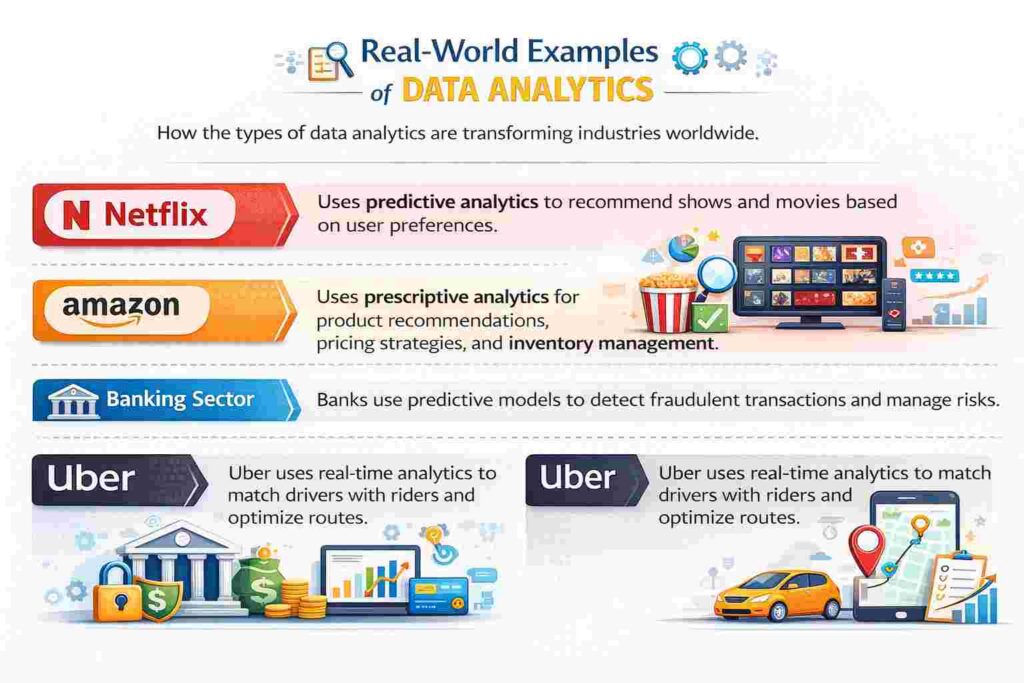
Uses predictive analytics to recommend shows and movies based on user preferences.
Amazon:
Uses prescriptive analytics for product recommendations, pricing strategies, and inventory management.
Banking Sector:
Banks use predictive models to detect fraudulent transactions and manage risks.
Uber:
Uber uses real-time analytics to match drivers with riders and optimize routes.
These examples highlight how the types of data analytics and their applications are transforming industries worldwide.
Future Scope of Data Analytics
The future of data analytics is extremely promising, with rapid advancements in technology. Understanding the types of data analytics and their applications will become even more important in the coming years.
Emerging Trends
Artificial Intelligence Integration:
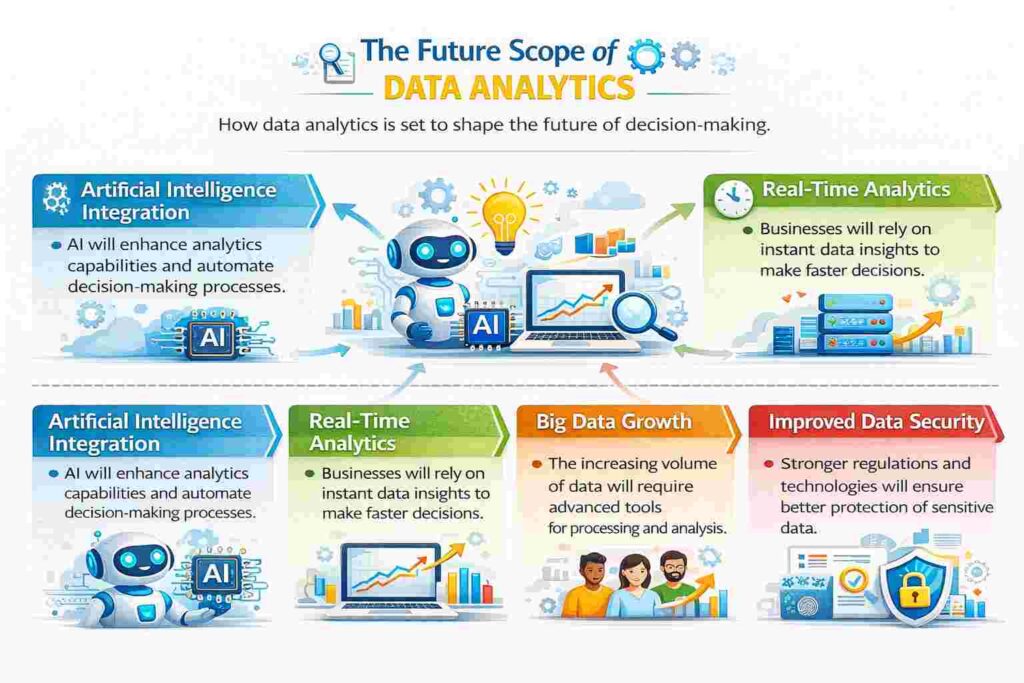
AI will enhance analytics capabilities and automate decision-making processes.
Real-Time Analytics:
Businesses will rely on instant data insights to make faster decisions.
Big Data Growth:
The increasing volume of data will require advanced tools for processing and analysis.
Data Democratization:
More people will gain access to analytics tools, making data-driven decisions easier.
Improved Data Security:
Stronger regulations and technologies will ensure better protection of sensitive data.
These trends indicate that the types of data analytics and their applications will continue to evolve and expand across industries.
Conclusion
In conclusion, the types of data analytics and their applications play a vital role in today’s data-driven world. From understanding past trends to predicting future outcomes and recommending actions, data analytics helps organizations make smarter decisions.
While it offers numerous benefits such as improved efficiency, better customer insights, and increased profitability, it also comes with challenges like high costs and data privacy concerns. However, with continuous advancements in technology, these challenges are gradually being addressed.
As the importance of data continues to grow, mastering the types of data analytics and their applications will be essential for individuals and businesses alike. Whether you are a student, professional, or entrepreneur, learning data analytics can open doors to new opportunities and long-term success.